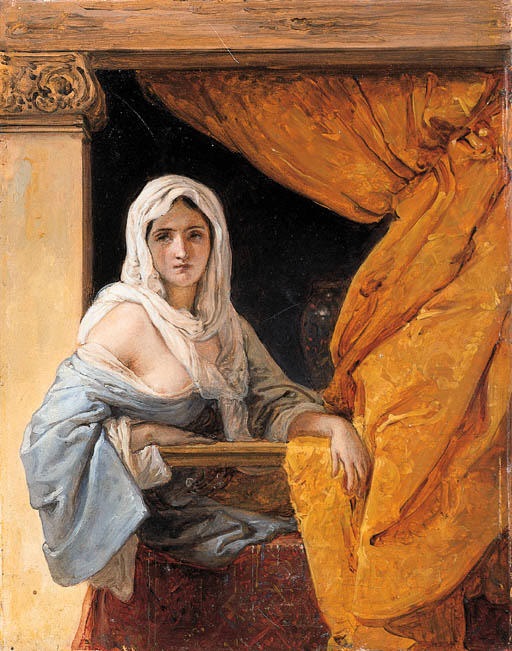
Odalisque, c. 1867
Oil On Canvas
82 x 68 cm – 1867
I have no further description, at this time
An odalisque was a chambermaid or a female attendant in a Turkish seraglio, particularly the court ladies in the household of the Ottoman sultan. In western usage, the term came to mean the harem concubine, and refers to the eroticized artistic genre in which a woman is represented mostly or completely nude in a reclining position, often in the setting of a harem. More on An odalisque
Francesco Hayez (10 February 1791–12 February 1882) was from a relatively poor family from Venice. Francesco was the youngest of five sons. He was brought up by his mother’s sister, who had married Giovanni Binasco, a well-off shipowner and art collector. Hayez displayed a predisposition for drawing since childhood.
His uncle, having noticed his precocious talent, apprenticed him to an art restorer in Venice. Hayez would later became a pupil of the painter Francesco Maggiotto with whom he continued his studies for three years.
He was admitted to the painting course of the New Academy of Fine Arts in Venice in 1806, where he studied under Teodoro Matteini. In 1809 he won a competition from the Academy of Venice for a one year residency at the Accademia di San Luca in Rome.
He remained in Rome until 1814, then moved to Naples where he was commissioned to paint a major work depicting Ulysses at the court of Alcinous. In the mid-1830s he attended the Maffei Salon in Milan, hosted by Clara Maffei. Maffei’s husband would later commissioned Hayez a portrait of his wife (See below). In 1850 Hayez was appointed director of the Brera Academy.
 Zaidan Gallery
Leave a comment