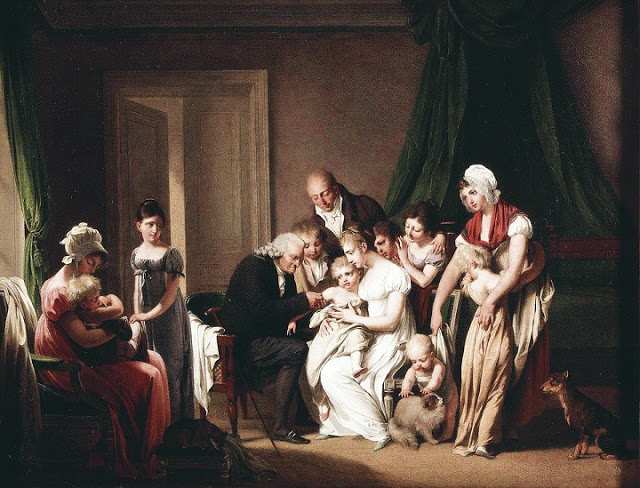
A Man Vaccinating a Young Child Held by Its Mother, with Other Members of the Household Looking On, c. 1807 (?)
Oil on canvas
H 44.5 x W 58 cm
Wellcome Collection
Smallpox was once a common epidemic disease that killed, blinded or disfigured its victims. In the eighteenth century its impact was reduced in Europe by a Chinese practice called variolation, the injection of smallpox fluid from an infected human being into a healthy human. In 1798 Edward Jenner proposed a modification of variolation called vaccination, which involved the injection of fluid from an infected cow into human beings. This painting, produced in France in about 1807, shows a family being vaccinated. The children are very scared of the new procedure, while the adults seem to be happy about it. Vaccination was at first not entirely accepted. It had been introduced from England to France in 1801, in a period in which the two countries were generally at war, so fear of poisoning by foreign agents could have been in some people’s minds at the time. Although vaccination against smallpox remained controversial for many years, and other types of vaccination such as MMR still are, it played a major part in the eventual elimination of smallpox. More on this painting
Louis-Léopold Boilly (5 July 1761–4 January 1845) was a French painter and draftsman. A gifted creator of popular portrait paintings, he also produced a vast number of genre paintings vividly documenting French middle-class social life. His life and work spanned the eras of monarchical France, the French Revolution, the Napoleonic Empire, the Bourbon Restoration and the July Monarchy. His 1800 painting Un Trompe-l’œil (See below) introduced the term trompe-l’œil (“trick the eye”), applied to the technique that uses realistic imagery to create the optical illusion that the depicted objects exist in three dimensions, though the “unnamed” technique itself had existed in Greek and Roman times…
 Zaidan Gallery
Leave a comment