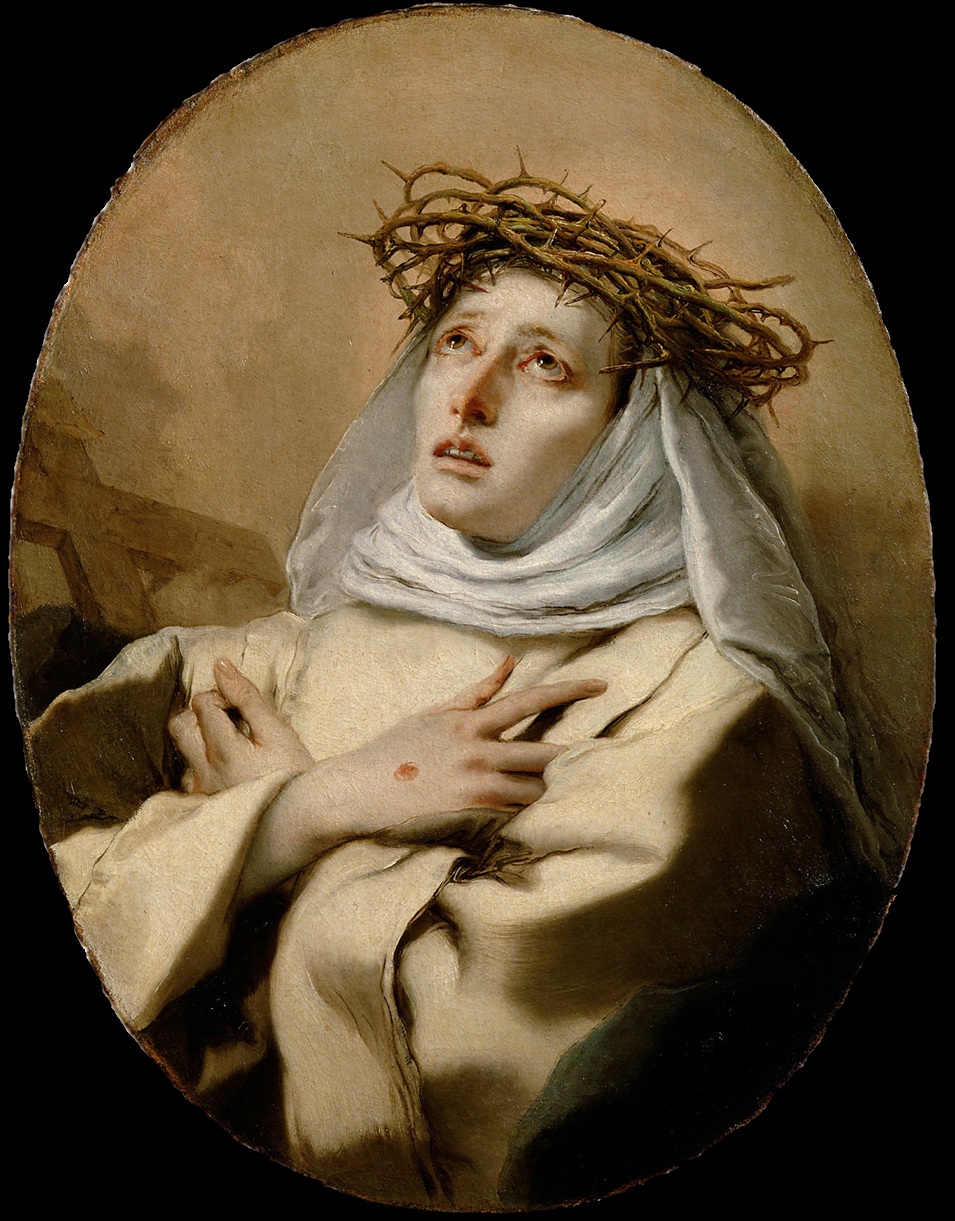
Saint Catherine of Siena, c. 1746
Oil on canvas
Oval: 70 x 52 cm
Kunsthistorisches Museum, Vienna
Giovanni Battista Tiepolo, 1696 – 1770. Born into a wealthy and noble family in Venice, Giambattista Tiepolo was recognized by contemporaries throughout Europe as the greatest painter of large-scale decorative frescoes in the 1700s. He was admired for having brought fresco painting to new heights of technical virtuosity, illumination, and dramatic effect. Tiepolo possessed an imagination characterized by one of his contemporaries as “all spirit and fire.”
A gifted storyteller, Tiepolo painted walls and ceilings with large, expansive scenes of intoxicating enchantment. In breath-taking visions of mythology and religion, the gods and saints inhabit light-filled skies. His ability to assimilate his predecessor and compatriot Paolo Veronese’s use of color was so profound that his contemporaries named him Veronese redivio (a new Veronese).
Tiepolo’s commissions came from the old established families of Italy, religious orders, and the royal houses of Spain, Germany, Sweden, and Russia. His frescoes adorn palaces, churches, and villas, and his artistic legacy consists of some eight hundred paintings, 2,400 drawings, two sets of etchings, and acres of fresco. When Tiepolo died at the age of seventy-four, a Venetian diarist noted the “bitter loss” of “the most famous Venetian painter, truly the most renowned…well known in Europe and the most highly praised in his native land.” More on Giovanni Battista TiepoloSaint Catherine de’ Ricci, O.S.D. (Caterina de’ Ricci) (23 April 1522 – 2 February 1590), was an Italian Dominican Tertiary sister. She is believed to have had miraculous visions and corporeal encounters with Jesus, both with the infant Jesus and with the adult Jesus. She is said to have spontaneously bled with the wounds of the crucified Christ. She is venerated for her mystic visions and is honored as a saint by the Catholic Church.
She was born Alessandra Lucrezia Romola de’ Ricci in Florence to a patrician family. At age 6 or 7, her father enrolled her in a school run by a monastery of Benedictine nuns in the Monticelli quarter of the city. There she developed a lifelong devotion to the Passion of Christ. She then entered the Convent of St Vincent in Prato, Tuscany, a cloistered community of religious sisters who followed the strict regimen of life she desired. In May 1535 she received the religious habit, and the religious name of Catherine, after the Dominican tertiary, Catherine of Siena.
Please follow link for full post
Please visit my other blogs: Art Collector, Mythology, Marine Art, Portrait of a Lady, The Orientalist, Art of the Nude and The Canals of Venice, And visit my Boards on Pinterest
Images are copyright of their respective owners, assignees or others. Some Images may be subject to copyright
I don’t own any of these images – credit is always given when due unless it is unknown to me. If I post your images without your permission, please tell me.
I do not sell art, art prints, framed posters or reproductions. Ads are shown only to compensate the hosting expenses.
If you enjoyed this post, please share with friends and family.
Thank you for visiting my blog and also for liking its posts and pages.
 Zaidan Gallery
Leave a comment