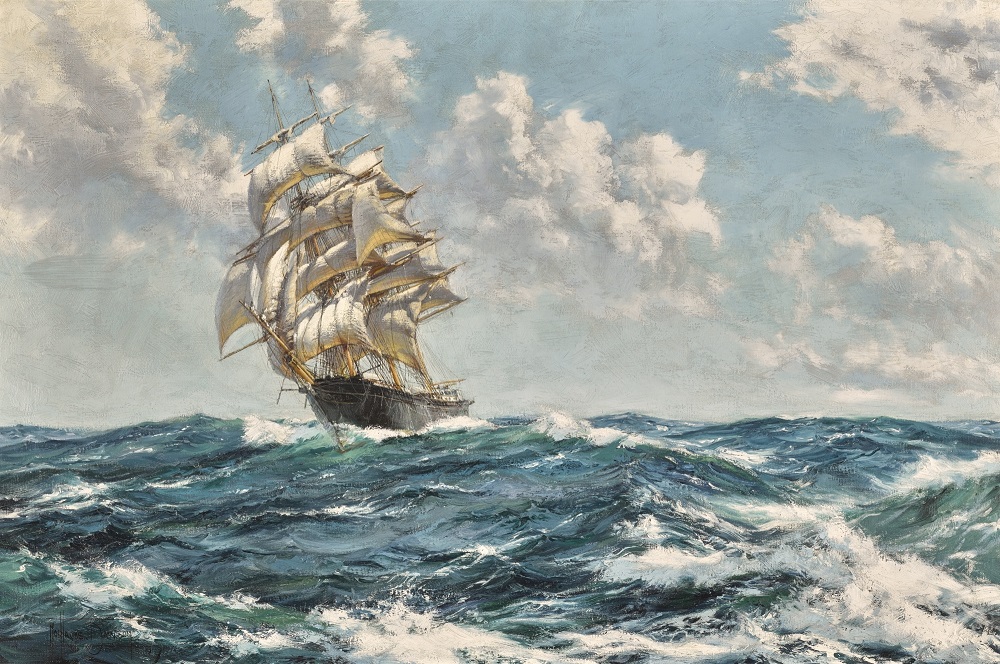
Montague Dawson, RMSA, FRSA (1890–1973)
GLEAMING FOAM, CHARIOT OF FAME
oil on canvas
61 by 91.5cm., 24 by 36in
Private collection
Chariot of Fame, a handsome clipper of 1639 tons built in America and flying the flag of the famous White Star Company. She had excellent accommodation for passengers, and before she was chartered by the Government to bring troops out to New Zealand to quell the Maori disturbances she had been in the Australian trade. She made several smart passages while in that trade, and on one occasion she did the run from London to Melbourne in 67 days.
the Chariot of Fame arrived in Auckland on January 8, 1864, under command of Captain Clark. After an uneventful passage of 92 days she landed 520 rank and file of the 58th, 70th, 18th, 40th, 57th, and 65th Regiments, and 64 women and 67 children. Many of these men were killed in the Waikato war. During the passage out a private of the 70th was washed overboard and drowned, and there were eight deaths—one adult and seven children.
The year before she was at Auckland the Chariot of Fame visited Lyttelton, where she arrived on January 29, 1863, with 460 passengers, of whom 430 were Government immigrants. She left London on October 29, 1862, and notwith-standing a detention of several days in the Channel she sighted the Snares on the eighty-first day out. On the coast she was further delayed by light winds and calms, and did not reach her destination until the ninety-second day out from the docks. More on Chariot of Fame
It is said that she came to her end in January, 1876, being abandoned when bound from Chincha Islands to Cork.
Montague Dawson RMSA, FRSA (1890–1973) was a British painter who was renowned as a maritime artist. His most famous paintings depict sailing ships, usually clippers or warships of the 18th and 19th centuries. Montague was the son of a keen yachtsman and the grandson of the marine painter Henry Dawson (1811–1878), born in Chiswick, London. Much of his childhood was spent on Southampton Water where he was able to indulge his interest in the study of ships. For a brief period around 1910 Dawson worked for a commercial art studio in Bedford Row, London, but with the outbreak of the First World War he joined the Royal Navy. Whilst serving with the Navy in Falmouth he met Charles Napier Hemy (1841–1917), who considerably influenced his work. In 1924 Dawson was the official artist for an Expedition to the South Seas by the steam yacht St.George. During the expedition he provided illustrated reports to the Graphic magazine.
After the War, Dawson established himself as a professional marine artist, concentrating on historical subjects and portraits of deep-water sailing ships. During the Second World War, he was employed as a war artist. Dawson exhibited regularly at the Royal Society of Marine Artists, of which he became a member, from 1946 to 1964, and occasionally at the Royal Academy between 1917 and 1936. By the 1930s he was considered one of the greatest living marine artists, whose patrons included two American Presidents, Dwight D Eisenhower and Lyndon B Johnson, as well as the British Royal Family. Also in the 1930s, he moved to Milford-Upon-Sea in Hampshire, living there for many years. Dawson is noted for the strict accuracy in the nautical detail of his paintings which often sell for six figures.
The work of Montague Dawson is represented in the National Maritime Museum, Greenwich and the Royal Naval Museum, Portsmouth. More on Montague Dawson
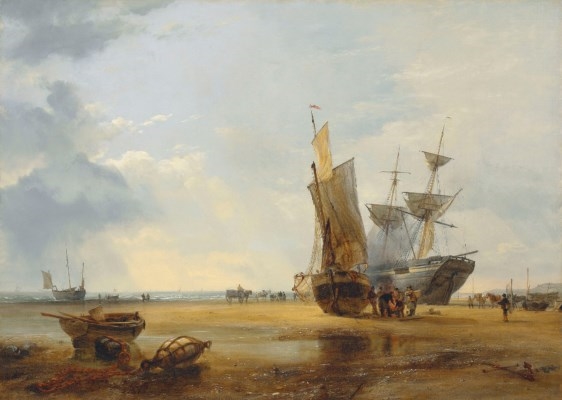
Edward William Cooke, 1811 – 1880
Brig on Sands: Vessels on the Sands at Hastings
oil on canvas
21 ½ x 30 in. (54.6 x 76.2 cm.)
Private collection
Hastings and the sea. In the 13th century Hastings had suffered over the years from the lack of a natural harbour. Attempts were made to build a stone harbour during the reign of Elizabeth I, but the foundations were destroyed by the sea in terrible storms. The fishing boats were stored on and launched from the beach.
Edward William Cooke, R.A., F.R.S., F.Z.S., F.S.A., F.G.S. (27 March 1811 – 4 January 1880) was an English landscape and marine painter, and gardener. Cooke was born in Pentonville, London. He was raised in the company of artists. He was a precocious draughtsman and a skilled engraver from an early age, displayed an equal preference for marine subjects and published his “Shipping and Craft” – a series of accomplished engravings – when he was 18, in 1829. Cooke began painting in oils in 1833, and first exhibited at the Royal Academy and British Institution in 1835, by which time his style was essentially formed.
He went on to travel and paint with great industry at home and abroad, indulging his love of the 17th-century Dutch marine artists with a visit to the Netherlands in 1837. He returned regularly over the next 23 years, studying the effects of the coastal landscape and light, as well as the works of the country’s Old Masters, resulting in highly successful paintings. He went on to travel in Scandinavia, Spain, North Africa and, above all, to Venice. In 1858, he was elected into the National Academy of Design as an Honorary Academician. . More Edward William Cooke

J. M. W. Turner, (1775–1851)
The Fish Market at Hastings Beach, c. 1810
Oil on canvas
Height: 908.05 mm (35.75 in). Width: 1,206.5 mm (47.5 in)
Nelson-Atkins Museum of Art, Kansas City, Missouri
Joseph Mallord William Turner, RA (baptised 14 May 1775 – 19 December 1851) was an English Romanticist landscape painter. Turner was considered a controversial figure in his day, but is now regarded as the artist who elevated landscape painting to an eminence rivalling history painting.
Although renowned for his oil paintings, Turner is also one of the greatest masters of British watercolour landscape painting. He is commonly known as “the painter of light” and his work is regarded as a Romantic preface to Impressionism. More on Joseph Mallord William Turner
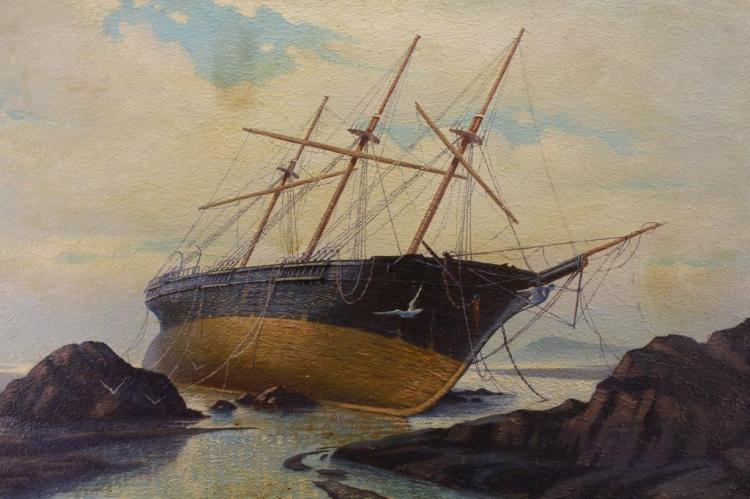
Henry Bernahl, (1900 – 1984)
Beached boat
Oil on board
23.5 x 35.5 in
Private collection
Henry Bernahl (1900-1984) was born in England on November 10, 1900. He moved to Australia at age eleven and soon shipped out as a seaman. While at sea, he acquainted himself with most all ocean-going craft which were later to become his painting forte. After moving to San Francisco in 1927, he worked as a towboat skipper and as a guide on the Balclutha where he maintained a studio and gallery. For health reasons, he later settled in Nevada City, California where he remained until his death on February 27, 1984. More on Henry Bernahl
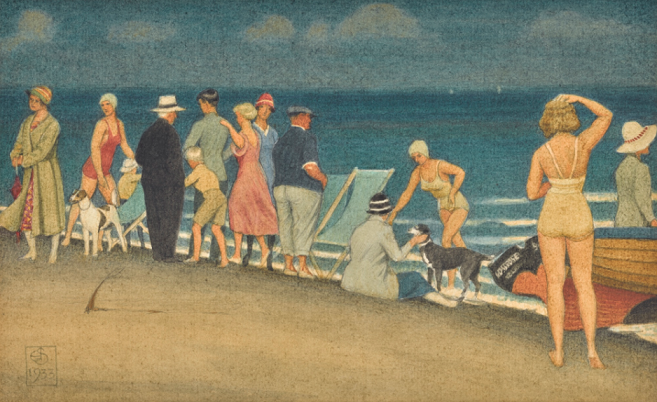
Joseph Edward Southall, R.W.S., R.B.S.A., N.E.A.C., 1861-1944
THE TRIPPERS, c. 1933 l.l.
Watercolour with pencil
16 by 25.5cm., 6¼ by 10in.
Private collection
A tripper is someone who visits a place for a short time, often with a large group of people:
Thousands of day trippers flock to resorts on the coast.
Joseph Edward Southall RWS NEAC RBSA (23 August 1861 – 6 November 1944) was an English painter associated with the Arts and Crafts movement.
A leading figure in the nineteenth and early twentieth-century revival of painting in tempera, Southall was the leader of the Birmingham Group of Artist-Craftsmen—one of the last outposts of Romanticism in the visual arts, and an important link between the later Pre-Raphaelites and the turn of the century Slade Symbolists.
A lifelong Quaker, Southall was an active socialist and pacifist, initially as a radical member the Liberal Party and later of the Independent Labour Party.
Southall was elected an Associate of the Royal Birmingham Society of Artists (RBSA) in 1898 and Member in 1902. He became President of the Society in 1939 and stayed in this post until his death in 1944. More on Joseph Edward Southall
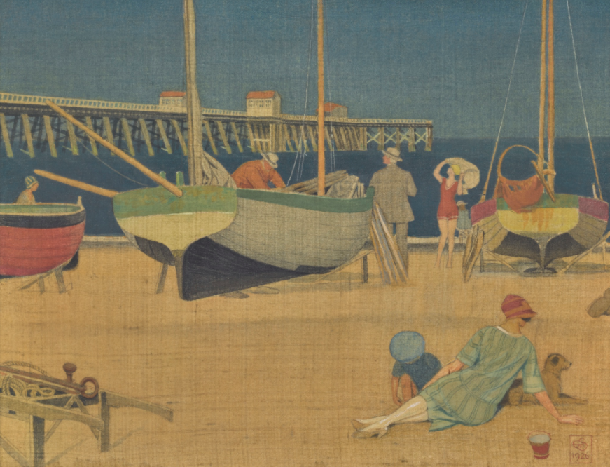
Joseph Edward Southall, R.W.S., R.B.S.A., N.E.A.C., 1861-1944
A GOLDEN EVENING, SOUTHWOLD, c. 1926 l.r.
Tempera over pencil on linen
29.5 by 37cm., 11½ by 14½in.
Private collection
Southwold is a small town on the English North Sea coast in the Waveney district of Suffolk. Southwold’s economy nowadays is mainly based on services, and particularly hotels, holiday accommodation, catering, and tourism. More on Southwold
Joseph Edward Southall, R.W.S., R.B.S.A., N.E.A.C., 1861-1944, see above
Images are copyright of their respective owners, assignees or others
We do not sell art, art prints, framed posters or reproductions. Ads are shown only to compensate the hosting expenses.
If you enjoyed this post, please share with friends and family.
 Zaidan Gallery
Leave a comment