Paul Delaroche, 1797 – 1856
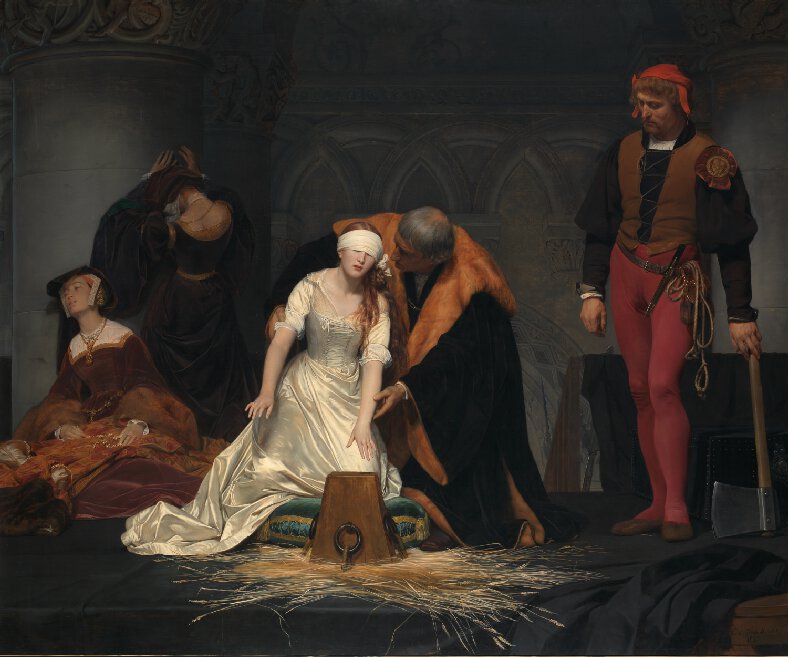
The Execution of Lady Jane Grey, c. 1833
Oil on canvas
246 × 297 cm
National Gallery
The Execution of Lady Jane Grey was enormously popular in the decades after it was painted, but in the 20th century realist historical paintings fell from critical favour and it was kept in storage. Restored and displayed again since 1975, it immediately once again became a highly popular work, especially with younger visitors.
Lady Jane Grey was the great-granddaughter of Henry VII of England and first cousin once removed to his grandson, the short-lived Edward VI. After Edward’s death she was proclaimed queen, being given precedence over Henry VIII’s daughters, Mary Tudor and Elizabeth. Two weeks after the death of her brother, Mary, who had the support of the English people, claimed the throne, which Jane relinquished, having reigned for only nine days. Jane, her husband Lord Guilford Dudley, and her father, were imprisoned in the Tower of London on charges of high treason. On Friday 12 February, Mary had Jane, then aged 16, and her husband beheaded. Her father followed two days later. More on Lady Jane Grey
Paul Delaroche (Paris, 17 July 1797 – 4 November 1856) was a French painter. He became famous in Europe for his melodramatic scenes that often portrayed subjects from English and French history. The emotions emphasised in Delaroche’s paintings appeal to Romanticism while the detail of his work along with the deglorified portrayal of historic figures follow the trends of Academicism and Neoclassicism. Delaroche aimed to depict his subjects and history with pragmatic realism.
Delaroche was born into a generation that saw the stylistic conflicts between Romanticism and Davidian Classicism. Davidian Classicism was widely accepted and enjoyed by society so as a developing artist at the time of the introduction of Romanticism in Paris, Delaroche found his place between the two movements. Later in the 1830s, Delaroche exhibited the first of his major religious works. His change of subject and “the painting’s austere manner” were ill-received by critics and after 1837, he stopped exhibiting his work altogether. At the time of his death in 1856, he was painting a series of four scenes from the Life of the Virgin. Only one work from this series was completed: the Virgin Contemplating the Crown of Thorns. More on Paul Delaroche

Fanny Nushka, France
Knee Down
Oil on Canvas.
20.5 H x 25.6 W x 1.2 in
“Discovering the painting The Execution of Lady Jane by Delaroche, I saw for one second a couple dancing. Realising it was a much darker subject, I decided to play on the ambiguity and to reconstruct the painting as such.” Fanny Nushka
Fanny Nushka, “I was born in 1983 in Lille, France and I now live in Marseille, Southern France. I am a figurative painter. American painter Maggie Siner gave me my first painting lessons when I was a teenager. Since then, I always painted – even when I was a student or a busy contemporary art gallery manager. In 2014 I decided to dedicate myself to painting. I am now a happy, self-taught and full-time painter.” More on Fanny Nushka
Please visit my other blogs: Art Collector, Mythology, Marine Art, Portrait of a Lady, and The Canals of Venice
Images are copyright of their respective owners, assignees or others. Some Images may be subject to copyright
I don’t own any of these images – credit is always given when due unless it is unknown to me. if I post your images without your permission, please tell me.
I do not sell art, art prints, framed posters or reproductions. Ads are shown only to compensate the hosting expenses.
If you enjoyed this post, please share with friends and family.
Thank you for visiting my blog and also for liking its posts and pages.
 Zaidan Gallery
Leave a comment