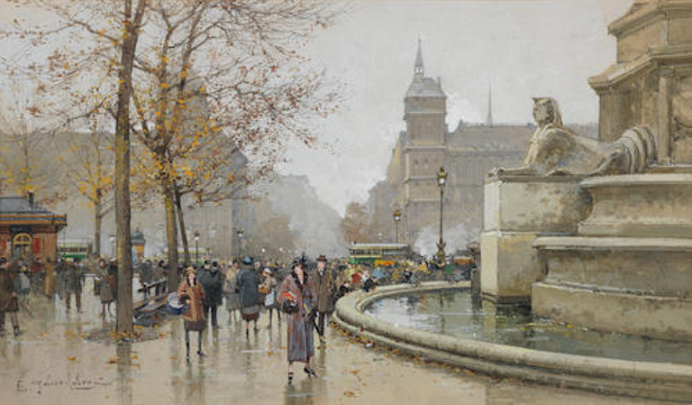
Eugène Galien-Laloue, (French, 1854-1941)
La fontaine du Palmier, place du Châtelet
Gouache
26 x 44.5cm (10 1/4 x 17 1/2in).
Private collection
The Fontaine du Palmier (1806-1808) or Fontaine de la Victoire is a monumental fountain located in the Place du Châtelet, between the Théâtre du Châtelet and the Théâtre de la Ville, in the First Arrondissement of Paris. It was designed to provide fresh drinking water to the population of the neighborhood and to commemorate the victories of Napoleon Bonaparte. It is the largest fountain built during Napoleon’s reign still in existence. More on The Fontaine du Palmier
Eugène Galien-Laloue (1854–1941) was a French artist of French-Italian parents and was born in Paris on December 11, 1854. He was a populariser of street scenes, usually painted in autumn or winter. His paintings of the early 1900s accurately represent the era in which he lived: a happy, bustling Paris, la Belle Époque, with horse-drawn carriages, trolley cars and its first omnibuses. Galien-Laloue’s works are valued not only for their contribution to 20th-century art, but for the actual history, which they document. His work can be seen at the Musée des Beaux-Arts, Louvier; Musée des Beaux-Arts, La Rochelle; Mulhouse, France.
A typical Galien-Laloue painting depicts sidewalks and avenues crowded with people or tourists mingling before the capital’s monuments. He also painted the landscapes of Normandy and Seine-et-Marne, as well as military scenes he was commissioned to produce in 1914. The Republic of France selected Galien-Laloue to work as a ‘war artist,’ both during the Franco-Prussian War and World War I, chiefly in watercolor. More on Eugène Galien-Laloue
Images are copyright of their respective owners, assignees or others. Some Images may be subject to copyright
We do not sell art, art prints, framed posters or reproductions. Ads are shown only to compensate the hosting expenses.
If you enjoyed this post, please share with friends and family.
 Zaidan Gallery
Leave a comment